How to Choose a Mobile App Development Partner for Your Automotive Business
On this page (15)
- Start With Your Own Goals
- 1. Technical Expertise
- 2. Portfolio and Case Studies
- 3. Automotive Industry Experience
- 4. Client Reviews and References
- 5. Communication and Collaboration
- 6. Development Process
- 7. UI/UX Design
- 8. Security and Compliance
- 9. Post-Launch Support and Maintenance
- 10. Pricing and Engagement Models
- Red Flags to Watch For
- Questions to Ask a Potential Partner
- Conclusion
- Frequently Asked Questions
For a car dealership, service centre, spare-parts seller or taxi operator, a mobile app is no longer a nice extra. It is where customers book a test drive, check on a repair, order a brake pad or call a cab. The app sits at the front of your business, so the team that builds it has a direct effect on your sales, your service quality and your reputation.
Plenty of agencies can build “an app”. Far fewer understand how a service bay is scheduled, how parts are catalogued by vehicle, or how a dispatch system assigns the nearest driver. This guide walks through what to evaluate when choosing a mobile app development partner for an automotive business, with examples from the kinds of apps the industry actually uses, plus a checklist of questions to ask before you sign.

Start With Your Own Goals
Before you speak to any vendor, be clear about what the app is for. “We need an app” is not a brief. These are briefs:
- Dealership: let buyers browse new and certified stock, compare models, book a test drive and get a trade-in offer without calling the showroom.
- Service centre: let customers book a slot, choose a service package, follow repair progress and pay before they arrive to collect the car.
- Spare-parts business: let workshops and vehicle owners find the right part quickly, check stock and track delivery.
- Taxi operator: give passengers booking, live tracking and in-app payment, and give drivers ride alerts and an earnings view.
Write down who the users are (customers, drivers, technicians, sales staff), which existing systems the app must talk to, and how you will measure success: test-drive bookings, service appointments booked through the app, repeat parts orders, completed rides. A good partner will ask about all of this in the first meeting. If they jump straight to screens and pricing, treat that as a warning sign.
1. Technical Expertise
Technical skill is the foundation, but in automotive it has to cover more than a polished front end.
Platforms and frameworks
Your customers use both Android and iOS, and drivers or technicians may use whatever device the business issues. Ask whether the partner builds natively or with cross-platform frameworks such as Flutter or React Native, and why they recommend one over the other for your app. For most dealership and service apps, a well-built cross-platform app gives consistent behaviour on both platforms from a single codebase.
Backend and real-time systems
The app is only as good as the backend behind it. A car service app needs reliable booking logic, so two customers are never given the same bay at the same time. A taxi app needs real-time location updates, driver matching and fare calculation that keep working at peak hour. A parts app needs a catalogue and stock levels that stay accurate. Ask the partner to explain how they would design the backend for your use case, not just which language they use.
Integrations
This is where generic developers most often struggle. An automotive app usually has to connect to:
- your dealer management system (DMS) for vehicle inventory, job cards and invoices;
- your CRM for leads, customer history and follow-ups;
- payment gateways supporting the methods your customers use, such as UPI, wallets and cards;
- maps and GPS services for live tracking, routing and arrival estimates;
- notification services for service reminders, order updates and offers.
Ask for specific examples of integrations they have built and how they handle failures, such as a payment that times out or a DMS that is temporarily unreachable.
Scalability
Plan for growth from day one. A dealer group may start with one showroom and add branches; a taxi operator may start in one city and expand to several. The architecture should let you add locations, users and features without a rebuild. Ask how the partner handles traffic spikes, which cloud infrastructure they use and how the app’s performance is monitored.
2. Portfolio and Case Studies
A portfolio shows what a partner has delivered; a case study shows how they think. Look for both.
When you review past work, check:
- Relevance: have they built apps similar to yours, such as booking, inventory, ordering or ride-hailing apps?
- Complexity: were these simple brochure apps, or did they involve real-time tracking, payments and integrations with business systems?
- Detail: does each case study explain the business problem, the approach, the technology used and the result?
- Live apps: can you download and use some of their apps yourself?
As an example of the detail you should expect, AutoTech360’s ride-hailing app case study sets out the client’s challenges (handling many concurrent ride requests, real-time driver matching, accurate GPS tracking, flexible payments and multi-city expansion), the microservices architecture and technology stack chosen to address them, and the results, including a 40% reduction in ride allocation time and expansion across multiple cities. Whichever partner you consider, ask for the same level of explanation, and be cautious of case studies that offer impressive numbers with no context.
3. Automotive Industry Experience
Domain knowledge shortens the learning curve and leads to better product decisions. A partner who already understands the industry will think of things you might not put in the brief:
- Car sales: buyers want to compare models side by side, customise colours and trims, view inspection reports for certified cars and get trade-in offers within the same journey. A new and certified car sales app should cover these without sending the buyer back to a phone call.
- Servicing: customers want real-time repair updates, a complete service history for each vehicle and reminders for oil changes, inspections and tyre rotations. Features such as voice-note instructions can save a lot of back-and-forth between customer and service advisor. See how a car service app brings these together.
- Spare parts: searching by category, brand, specification or VIN reduces wrong orders and returns, while barcode scanning keeps stock accurate. An automobile spare parts app also needs delivery tracking and live inventory so critical parts don’t run out.
- Taxi and ride-hailing: separate passenger and driver apps, driver onboarding and scheduling, ride assignment, ratings and an admin dashboard. A specialist taxi app development company will have solved these problems before.
Ask candidates to walk you through how they would handle one of these workflows. Their answer will quickly show whether they understand the business or are learning it at your expense.
4. Client Reviews and References
Reviews show what working with a partner is actually like. Look at independent review platforms as well as testimonials on the partner’s own website, and pay more attention to the detail of reviews than to star ratings.
Useful signals include:
- comments about meeting deadlines and budgets;
- how the team handled problems or changes in scope;
- whether clients stayed with the partner for ongoing support;
- recent reviews, not just ones from several years ago.
Where possible, ask for a reference you can speak to, ideally another automotive business. Ask them what went wrong during the project and how it was resolved. Every project has problems; what matters is how the partner responds.
5. Communication and Collaboration
Many app projects fail through poor communication rather than poor code. Before you commit, find out:
- who your day-to-day contact will be, and whether you will have direct access to the project manager and lead developer;
- how often you will get progress updates and demos;
- which tools they use for task tracking and feedback;
- how quickly they respond, and how working hours and time zones line up with yours.
An agile, iterative approach suits most automotive apps. Your service advisors, sales staff or drivers can try early versions and give feedback before launch, which is far cheaper than discovering a confusing booking flow after release. A partner who welcomes this kind of feedback will produce an app your team actually uses.
6. Development Process
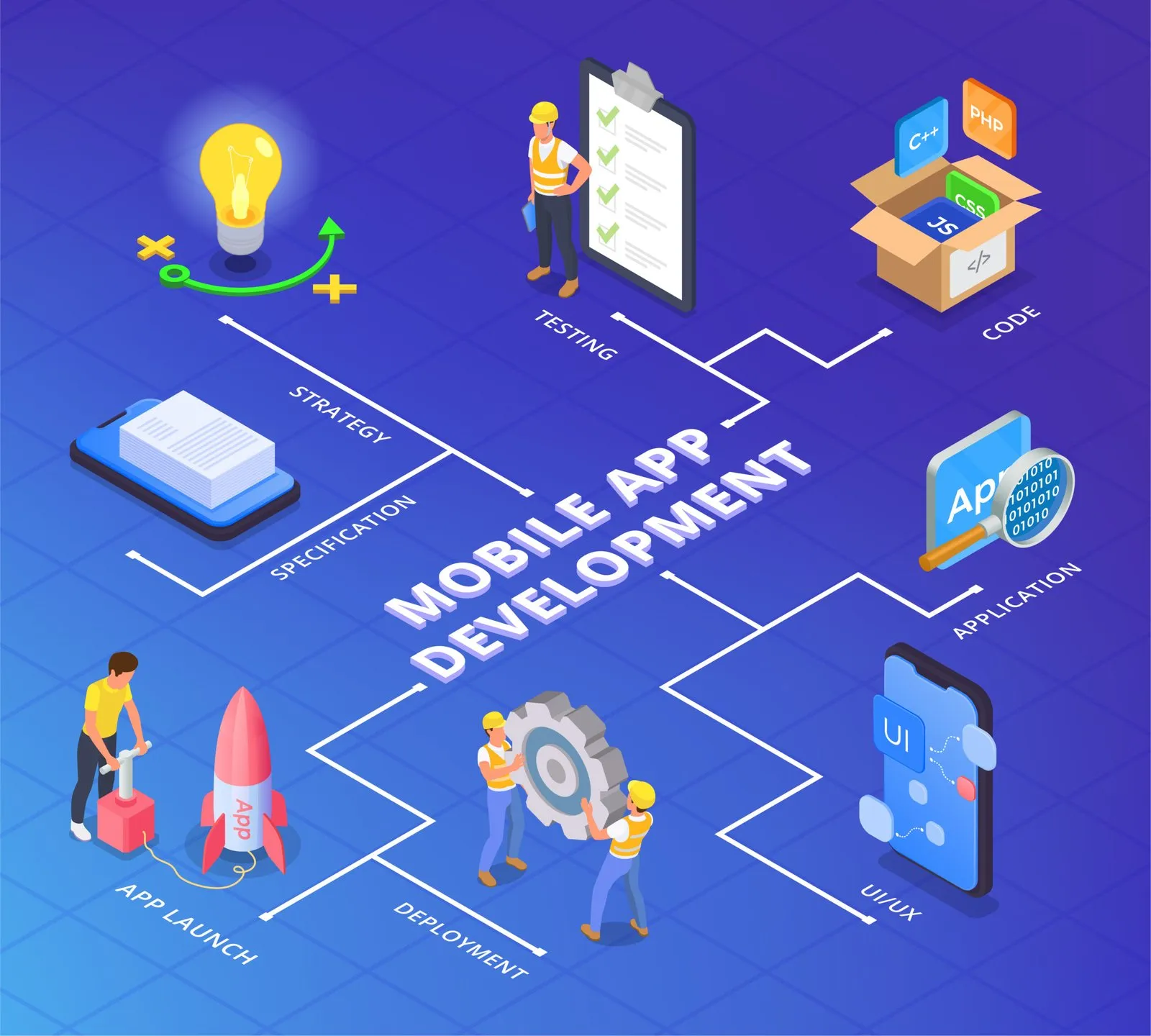
A structured process makes timelines and costs predictable. A typical process includes:
- Discovery and requirements: understanding your workflows, users, integrations and success measures.
- UI/UX design: wireframes and clickable prototypes you can test with real users before development begins.
- Development in sprints: working features delivered regularly, so you see progress and can adjust priorities.
- Testing: functional, performance and security testing across devices, including real-world conditions such as weak mobile signal for drivers on the road.
- Launch: app store submission, deployment and staff training.
- Post-launch monitoring: tracking crashes, performance and user behaviour, then improving.
Ask to see a sample project plan. A partner without a clear process is likely to deliver late or over budget.
Custom build or ready-to-use app?
It is also worth asking whether you need a fully custom app at all. Some automotive needs, such as car rental, car wash bookings, roadside assistance, spare-parts sales, car sales, servicing and taxi booking, are well served by ready-to-use apps that can be branded, customised and integrated with your existing systems. These can often be deployed far faster than a custom build. A good partner will tell you honestly which route suits your business rather than defaulting to the more expensive option.
7. UI/UX Design
Your app’s users range from first-time car buyers to busy fleet drivers. Design has to work for all of them. Look for a partner who:
- researches your users before designing screens;
- keeps key journeys short, such as booking a service in a few taps or confirming a ride with one;
- designs for consistency across phones, tablets and screen sizes;
- considers accessibility, including readable text, clear contrast and simple language;
- uses analytics after launch to find where users drop off and improve those screens.
Ask to try prototypes or live apps from their portfolio. If you find a booking flow confusing, so will your customers.
8. Security and Compliance
Automotive apps handle personal details, vehicle information, location data and payments. A breach damages customer trust and your brand. When evaluating a partner, ask about:
- Secure coding practices and how code is reviewed;
- Encryption of data in transit and at rest;
- Authentication, such as OTP login and role-based access, so a driver, technician and manager each see only what they need;
- Payment security, using established payment gateways rather than storing card details in the app;
- Data protection and compliance with the privacy laws that apply to your customers;
- Security testing before launch and on a regular schedule afterwards.
Location data deserves particular care in taxi and fleet apps. Ask how the partner limits who can see live location and how long that data is stored.
9. Post-Launch Support and Maintenance
Launch is the beginning, not the end. Operating systems update, payment providers change their APIs, and your business will want new features. Make sure the partner offers:
- bug fixes and performance improvements;
- updates for new Android and iOS versions;
- security patches and monitoring;
- feature enhancements as your needs grow, such as adding a new branch or a loyalty programme;
- clear support terms, ideally a service level agreement (SLA) covering response times.
Ask who will support the app after launch and whether it will be the same team that built it. A partner who disappears after go-live leaves you with an app nobody understands.
10. Pricing and Engagement Models
Cost matters, but the cheapest quote is rarely the cheapest outcome. Look for transparent pricing with a clear breakdown of what is included. Common engagement models include:
- Fixed price: best when requirements are clear and stable, such as a branded version of a ready-to-use app with defined customisations.
- Time and materials: best when requirements will evolve, such as a custom app being built alongside new business processes.
- Dedicated team: best for larger, ongoing programmes where you want a team working on your product over a long period.
- Hybrid: a fixed price for a defined first release, then time and materials for later improvements.
Whichever model you choose, confirm what happens when requirements change, who owns the source code, and what ongoing costs to expect for hosting, third-party services and maintenance.
Red Flags to Watch For
Be cautious if a potential partner:
- quotes a price far below everyone else without explaining why;
- promises unrealistic timelines for a complex app;
- cannot show relevant work or explain their past projects in detail;
- has no structured process or testing approach;
- gives vague answers about security, data handling or integrations;
- offers no clear post-launch support;
- is slow or unclear in communication before you have even signed.
Questions to Ask a Potential Partner
Use this checklist in your first conversations with shortlisted vendors.
| Area | Question to ask | What a good answer looks like |
|---|---|---|
| Industry experience | Which automotive apps have you built? | Specific examples, such as service booking, car sales, parts or taxi apps |
| Integrations | Can the app connect to our DMS, CRM and payment gateway? | Clear explanation of how, with past examples |
| Real-time features | How do you handle live tracking and notifications? | Describes architecture, maps services and failure handling |
| Process | What does your development process look like? | Defined stages, regular demos, testing before launch |
| Security | How do you protect customer, location and payment data? | Encryption, secure authentication, regular security testing |
| Ownership | Who owns the source code and data? | Clearly stated in the contract |
| Support | What happens after launch? | Defined maintenance plan and support terms |
| Pricing | What is included in the quote, and what costs extra? | Transparent breakdown, including ongoing costs |
| Build approach | Do we need a custom app or a ready-to-use one? | An honest recommendation based on your needs |
Conclusion
The right mobile app development partner for an automotive business combines solid technical skills with a real understanding of how dealerships, service centres, parts sellers and taxi operators work. Judge candidates on relevant experience, integration capability, security, communication and long-term support, not just on price or a slick portfolio.
AutoTech360 builds mobile apps for automotive businesses, including ready-to-use apps for car rental and leasing, car wash booking, roadside assistance, car sales, servicing, spare parts and taxi booking, which can be customised and integrated with your existing systems. If you would like to see how they would work for your business, book a demo.
Frequently Asked Questions
Why choose a partner with automotive experience instead of a general app agency?
An automotive-focused partner already understands workflows such as service bookings, vehicle inventory, parts catalogues and ride dispatch. That means fewer misunderstandings, better feature suggestions and less time spent explaining how your business works.
Can a mobile app integrate with our existing dealer management system or CRM?
It should. Ask any potential partner how they would connect the app to your DMS, CRM and payment gateway, and for examples of similar integrations. AutoTech360’s apps are designed to integrate with existing systems.
Should we build a custom app or use a ready-to-use app?
If your needs match a common use case, such as car rental, car wash bookings, roadside assistance, car sales, servicing, spare-parts sales or taxi booking, a ready-to-use app that is branded and customised can launch much faster. A custom build makes sense when your workflows are unusual or the app is central to a new business model.
What should be included in post-launch support?
At a minimum: bug fixes, updates for new Android and iOS versions, security patches, performance monitoring and a clear process for requesting new features, ideally backed by agreed response times.
How do we compare quotes from different partners?
Compare what is included, not just the headline price. Check scope, number of platforms, integrations, testing, source-code ownership and ongoing support costs. A low quote that excludes integrations or maintenance often costs more in the end.